Hannover Coin List
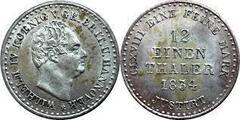
Germany-States | 1/12 thaler
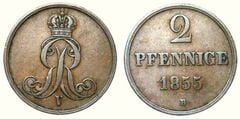
Germany-States | 2 pfennig
The most valuable and popular coins
The most valuable Hannover coins and sought after by collectors according to Foronum statistics are the following:

Historical information
The Hanoverian era in Germany was a significant period in the country's numismatic history. From 1714 to 1837, the House of Hanover ruled both the Electorate of Hanover and the Kingdom of Great Britain, which greatly influenced coinage in both territories.
The Hanoverian monetary system
During this period, Hanover maintained its own monetary system based on the Taler, a silver coin that became the main unit of account. The Hanover Taler was divided into 24 Gute Groschen or 288 Pfennige. In addition to Talers, other denominations such as Mariengroschen and Pfennige were minted in copper. Hanoverian coins of this era often featured the portraits of Hanoverian monarchs, such as George I, George II and George III, who were also kings of Great Britain. These pieces are highly valued by collectors because of their historical significance and mintage quality.
British influence on Hanover numismatics
The personal union between Hanover and Great Britain had a significant impact on the numismatics of both territories. Some Hanover coins incorporated elements of British design, such as the use of Latin in legends and the inclusion of British royal titles alongside Hanoverian ones. A notable example is the silver "Krone," minted during the reign of George III, which featured the combined coat of arms of Hanover and Britain. This fusion of styles created unique pieces that reflected the complex political relationship between the two states. The Hanoverian era ended in 1837 when Queen Victoria ascended to the British throne, but the Salic laws prevented her from inheriting Hanover, thus separating the two kingdoms and marking the end of this fascinating numismatic era.