
Wurttemberg Coin List
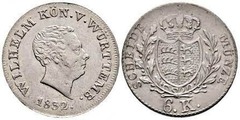
Germany-States | 6 kreuzer
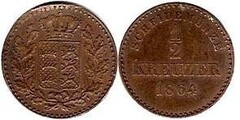
Germany-States | 1/2 kreuzer
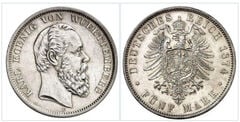
Germany-States | 5 mark
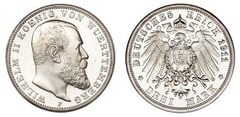
Germany-States | 3 mark (William II)
The most valuable and popular coins
The most valuable Wurttemberg coins and sought after by collectors according to Foronum statistics are the following:

Historical information
The Kingdom of Württemberg, located in southwestern Germany, had a fascinating history that is reflected in its coins. From its elevation to a kingdom in 1806 until its dissolution in 1918, Württemberg underwent significant changes in its monetary system, which are a testament to its political and economic evolution.
The monetary system of Württemberg
For much of its existence as a kingdom, Württemberg used the Gulden system, divided into 60 Kreuzer. This system was common in southern Germany and Austria. However, after German unification in 1871, Württemberg adopted the Deutsche Mark as its official currency. Coins from this period are particularly interesting to collectors, as they show the transition from a regional to a national monetary system. The most common pieces included denominations in Kreuzer and Gulden, as well as later in Pfennig and Mark, often featuring the Württemberg coat of arms or the portrait of the reigning monarch.
Coin characteristics and designs
Württemberg coins are notable for their high mintage quality and detailed designs. Portraits of monarchs, such as King Wilhelm I and King Karl, are especially prized for their precision and craftsmanship. The reverse of the coins often featured heraldic motifs, such as the stag horns and lions of the Württemberg coat of arms. During the period of the German Empire, Württemberg coins retained distinctive local characteristics, although they conformed to national standards. Some special issues, such as the coins commemorating King Karl's jubilee in 1889, are particularly coveted by collectors because of their rarity and historical significance.