Investing in gold and silver coins: a complete guide to investing in bullion wisely
Investing in gold and silver coins is a decision that combines financial logic, financial acumen and an understanding of the physical market. Unlike other assets, the precious metal does not depend on the promise of payment from a third party or the solvency of an entity. It is a tangible asset, with intrinsic value and international recognition.
However, investing in coins is not simply a matter of going to a store and buying the most attractive piece. The price paid, the applicable taxation, the time of the cycle, the accumulation strategy and future liquidity are determining factors in the final profitability.
In order to invest wisely, it is essential to understand what spot is, what premium is, how the real value of the metal is calculated and what role bullion coins play in this market.

What are Bullion coins and why are they the basis of gold and silver investment?
When we talk about investing in gold and silver coins, we are actually referring, in most cases, to the so-called bullion coins.
A bullion coin is a piece minted by an official mint whose value depends essentially on its precious metal content. Although they are legal tender in their country of issue, their face value is merely symbolic and bears no relation to their real market value. What is being acquired is not a coin for circulation, but a precise amount of internationally recognized fine metal.
These coins are characterized by standardized weights -usually one troy ounce or fractions thereof- and high purity, usually 999 or 999.9 thousandths. Their design usually remains stable or changes slightly every year, but their purpose is not collecting but investment.
Among the most internationally recognized gold bullion coins are the American Gold Eagle, the Canadian Gold Maple Leaf, the Krugerrand and the Vienna Philharmonic. All of them contain one ounce of fine gold -although in some cases the purity is 916.7 with alloy for greater resistance- and enjoy extraordinary liquidity in the secondary market.
In silver, the most common references are the American Silver Eagle, the Canadian Silver Maple Leaf, the Britannia and the Silver Philharmonic. These pieces are widely accepted and form the basis of physical silver investment.
The investor who chooses bullion is primarily looking for liquidity, transparency in price formation and a reasonable premium over the metal.

The spot price: the international metal reference
The starting point for any investment in precious metals is the spot price. This represents the international quotation of gold or silver for immediate delivery on the wholesale markets.
The spot price is not the price paid by the individual investor, but the reference on which the physical market is built. It is the theoretical value of the pure metal in large volumes and under international standards. We recommend you to see our article on metal prices.
When you look at the chart of gold or silver, you are essentially analyzing the evolution of the spot. That movement reflects interest rate expectations, central bank decisions, geopolitical tensions, dollar strength and institutional capital flows.
Understanding that the spot is the basis, but not the final price, is essential to avoid misinterpretation.
The Premium: the real cost of accessing physical metal
The premium is the difference between the spot price and the price finally paid by the investor for a physical coin. This difference is not arbitrary; it responds to a series of real costs such as minting, logistics, insurance and the distributor's commercial margin.
On one-ounce gold coins, the premium is usually relatively small in percentage terms. On fractional coins, that premium usually increases because manufacturing costs do not decrease proportionally to weight.
In silver, the premium is usually higher than in gold because of the lower unit value of the metal, which causes logistics and production costs to have a greater percentage impact.
The premium can also widen in times of strong physical demand or supply stress. Controlling the premium is therefore one of the fundamental keys to efficient bullion investment.
Metal value: how to calculate the real intrinsic value
The intrinsic value of a bullion coin depends exclusively on its fine metal content. To calculate it, simply multiply the fine weight by the spot price. On a one ounce pure gold coin, the metal value will be roughly equivalent to the spot price of gold. For historical or alloy coins, the calculation requires precise knowledge of the exact fine metal content.
This exercise allows the investor to mentally separate the metal value from the additional cost of the premium. This distinction is crucial when evaluating buying opportunities.
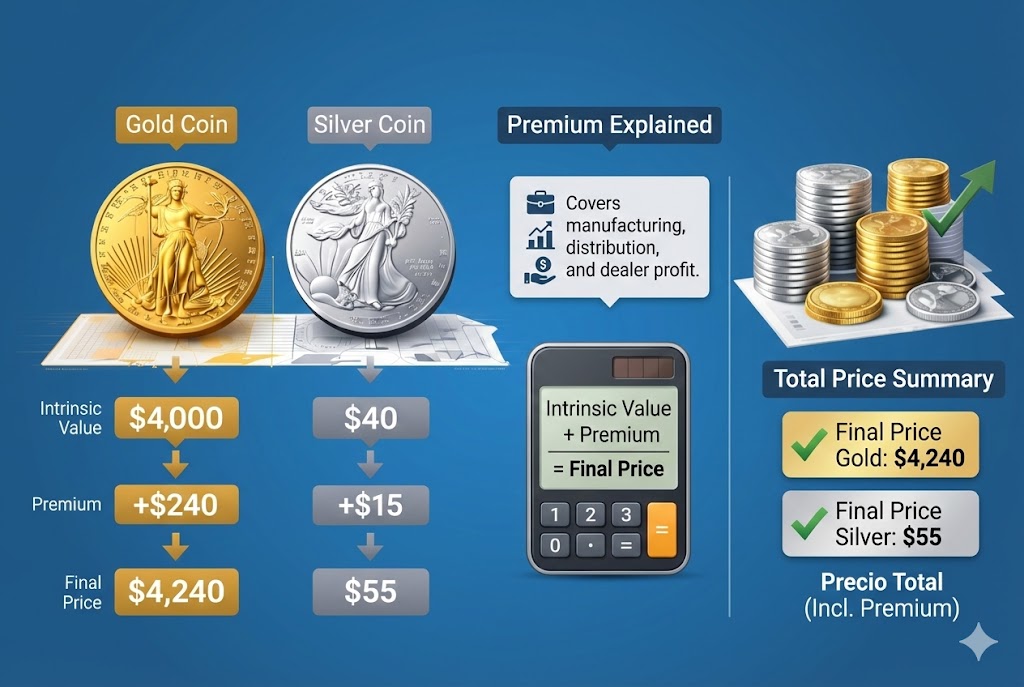
Practical example: understanding the relationship between Premium and Spot
We start from the following situation:
The spot price of gold is €4,000 per ounce.
VAT and taxation on gold and silver coins
One of the most relevant - and often least understood - aspects is taxation.
In the European Union, investment gold that meets certain purity requirements is exempt from VAT. This makes bullion gold a tax-efficient instrument.
Silver, on the other hand, is subject to VAT in most jurisdictions, which significantly increases the initial cost. Special regimes exist in certain secondary markets, but are not always available or applicable to all transactions.
This tax differential partly explains why many investors prioritize gold over silver in pure wealth strategies.
Investment Strategies: Periodic Buying and DCA Method
Trying to hit the market bottom is an extremely complex task. For this reason, many investors resort to progressive accumulation strategies such as the method known as Dollar Cost Averaging (DCA).
Periodic buying consists of acquiring physical metal at regular intervals, regardless of the point price. This methodology reduces the emotional impact of volatility and allows the acquisition cost to be averaged over time.
In physical metals, this strategy can be adapted to quarterly or semi-annual purchases to optimize shipping costs and premiums. The objective is not to speculate on short-term movements, but to build a solid position in a disciplined manner.
Where to buy gold and silver coins and what aspects to evaluate
The choice of the supplier is as important as the moment of purchase. Purchasing coins from professional dealers, established numismatic houses or specialized platforms with a proven reputation reduces authenticity risks and improves transparency in price formation.
The investor must analyze the differential between sale and repurchase price, the clarity of the cost structure and the solvency of the intermediary. Buying just to find the lowest price can be a mistake if there is no full guarantee on the provenance and authenticity of the metal.
Where to sell and how to preserve liquidity
Liquidity is one of the great attractions of bullion. Internationally recognized coins can be sold relatively easily on the secondary market.
However, it is advisable to know in advance the repurchase conditions of the supplier or the local market. The spread between buying and selling, the state of preservation and the current demand will influence the final price.
Planning the exit before even making the purchase is a sign of responsible investment.
Custody, time horizon and common errors
Investing in physical metal involves deciding how to store it. Home security, bank safe deposit boxes or specialized safekeeping services have different advantages and costs. This decision must be integrated into the overall return calculation.
The time horizon is also critical. Gold and silver should not be seen as short-term speculative instruments, but as assets for wealth preservation and diversification.
Among the most common mistakes are buying at times of media euphoria, ignoring the impact of the premium or not considering taxation.
Check the updated value of your currencies on Foronum
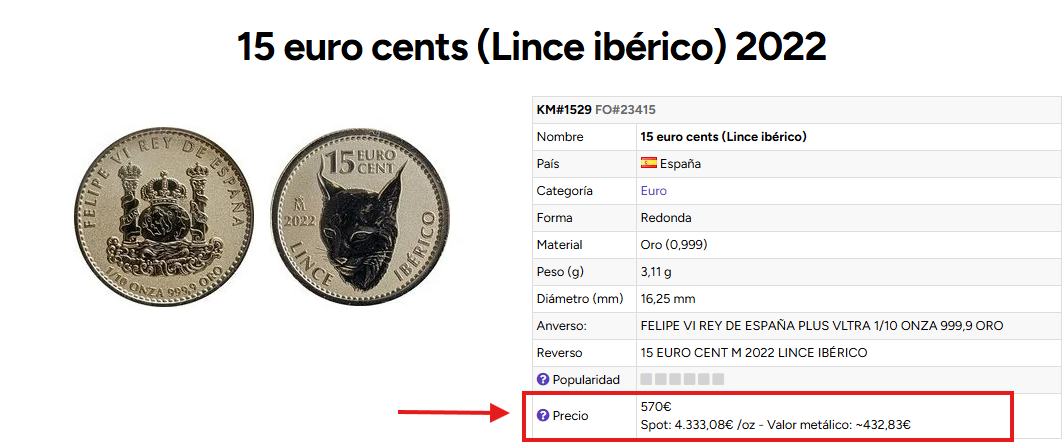
Manually calculating the intrinsic value of each coin is useful to understand the market, but in practice the investor needs constantly updated data. In Foronum, from the individual tab of each coin you can consult the updated spot price and the intrinsic value recalculated daily according to the price of the metal. This allows you to know at all times how much the metal content of each piece is really worth.
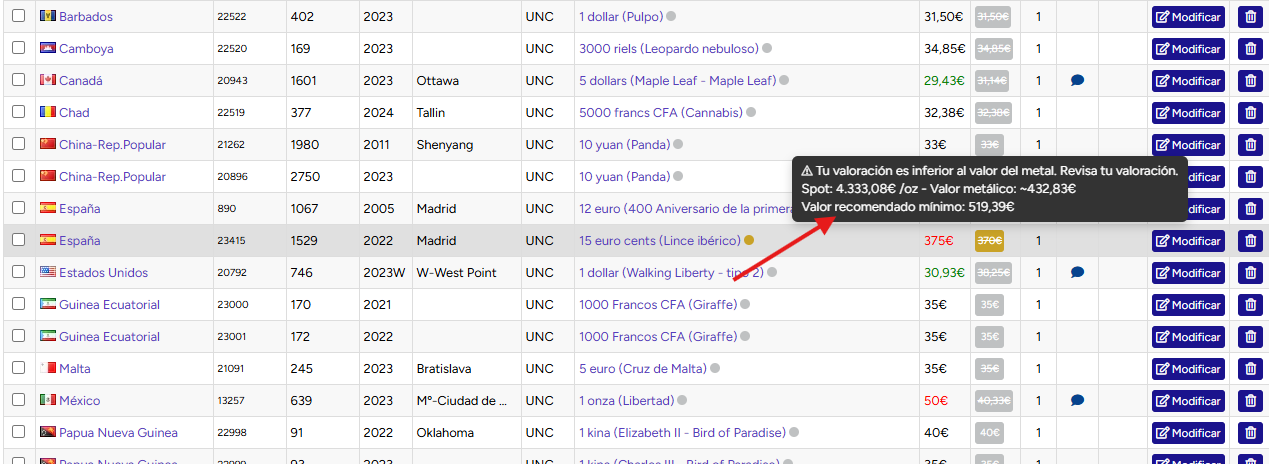
In addition, premium users have advanced tools within their personal collection: they can receive indicative price recommendations and immediately visualize when a coin is trading below its metal value, which makes it easier to detect more informed buying opportunities and always have the value of the collection up to date. This integration between price, intrinsic value and personalized tracking makes investing in coins a much more transparent and strategic process.
Conclusion: Discipline, knowledge and long-term view
Investing in gold and silver coins is a sound strategy when it is based on knowledge and discipline. Understanding the spot, controlling the premium, assessing taxation and defining a coherent strategy are essential steps.
Bullion coins offer liquidity, international recognition and an efficient way to own physical metal. But as with any investment, profitability depends not only on the asset, but on how and when it is acquired, and on the planning of its eventual sale.
Investing in gold and silver is not an impulsive act. It is a strategic decision that, if well executed, can play an important role in the protection and diversification of wealth.